Math and space: 10 home activities to explore the sky with kids
Ten safe activities for the home or the backyard, each with a suggested age and the math behind it: Moon phases, shadows, counting stars and more.
The sky is the biggest classroom there is, and it charges no admission. A clear night in the yard or some fruit on the kitchen table is all it takes for your child to count, measure and compare without feeling like it’s homework.
Each activity lists a rough age range and the math it practices. The ages are flexible: with a bit more help, a six-year-old can do almost all of them.
Before you start: three safety rules
- Never look directly at the Sun, not with sunglasses, not with binoculars, not through a phone camera. It can damage the eyes. In the shadow activities, you look at the ground.
- Night outings always with an adult, somewhere familiar: the yard, the building’s rooftop terrace, the grandparents’ house.
- Scissors, flour and pebbles under supervision, especially with the little ones.
The 10 activities
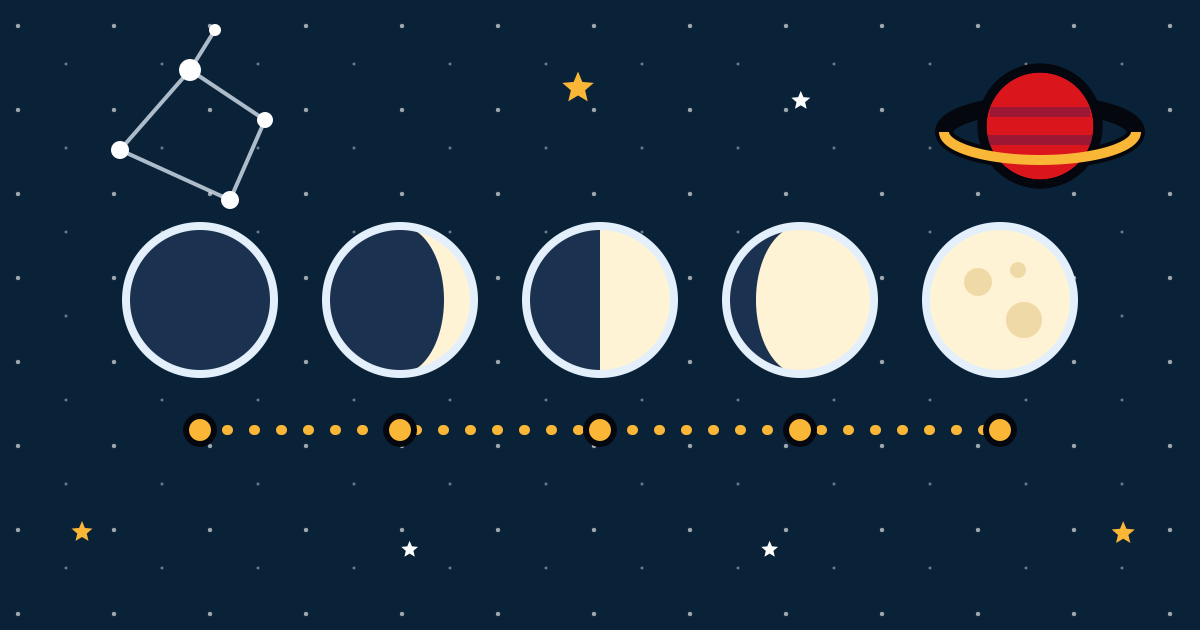
1. A Moon phase diary
Ages: 5–12 · Math: counting, calendars, patterns
For a month, go out every night you can to look at the Moon and draw it in that day’s box on a calendar. If it’s cloudy, draw a cloud.
By the end, a pattern appears: the lit part grows until the full moon and then shrinks. The full cycle takes about 29.5 days. Older children can count the days between two full moons.
2. The solar system in fruit
Ages: 6–12 · Math: comparing sizes, ordering, proportion
If Earth is a grape, Jupiter, about 11 times wider, is a big melon. Saturn, about 9 times, is a smaller melon. Uranus and Neptune, about 4 times, are two oranges. Venus is another, slightly smaller grape, Mars a chickpea (half the width) and Mercury a pigeon pea, the guandú of Panamanian rice.
Your child lines the planets up from largest to smallest. Then comes the question that surprises everyone: what about the Sun? It’s a star, about 109 times wider than Earth. With a 2 cm grape, the Sun would measure 109 × 2 = 218 cm: taller than your front door.
3. The distance to the Moon with a string
Ages: 8–12 · Math: measurement, multiplication, scale
Find a ball for Earth and a smaller one for the Moon. Measure the width of the big ball. The Moon is about 30 Earth diameters away: if the ball is 20 cm wide, the string needs to be 20 × 30 = 600 cm, or 6 meters.
Stretch the string down the hallway with a ball at each end.
4. Counting stars in a square
Ages: 7–12 · Math: estimation, sampling, averages
Cut a square window about 10 cm on each side out of a piece of cardboard. On a dark night, hold it at arm’s length and count the stars inside the window. Repeat in four or five parts of the sky and work out the average.
That’s how huge quantities are estimated: you count a sample and multiply. In Panama City, the city lights hide many stars. If you take a weekend trip to the interior, count again and compare.
5. Measuring shadows through the day
Ages: 6–12 · Math: measurement, tables, bar graphs
On a sunny day, push a stick into the ground or fix a bottle in place in the yard. Every hour, from mid-morning to mid-afternoon, mark the tip of the shadow with chalk, measure it and write the time and length in a table.
With that data, your child can draw a bar graph on squared paper. The shadow is shortest around midday, longer in the morning and afternoon, and it changes direction too.
6. Flour craters
Ages: 5–10 · Math: measurement, comparison, how two quantities relate
Fill a tray with 3 or 4 cm of flour and dust a little cocoa on top. Drop the same pebble from 20, 50 and 100 cm, measured with the tape, and measure the width of each crater with a ruler.
Younger kids compare: bigger or smaller. Older kids write down the data and ask: if I double the height, does the crater double? Let them find out. Most of the Moon’s craters were also made by impacts.
7. Constellations with a ruler and protractor
Ages: 8–12 · Math: geometry, shapes, angles
Orion is easy to see in the evening, roughly from December to March; look for the three stars in a row that form its belt. Your child draws the dots they see and then joins them with a ruler.
What shapes appear? Triangles, quadrilaterals? Older children can measure the angles with a protractor.
8. How old would you be on Mars?
Ages: 9–12 · Math: division, unit conversion
A year is the time a planet takes to go once around the Sun. On Mars it lasts about 687 Earth days; on Jupiter, about 12 Earth years.
On Jupiter, a ten-year-old hasn’t even turned one yet. For Mars, convert to days first: 10 × 365 = 3650 days, and 3650 ÷ 687 comes to just over 5 Martian years.
9. Timing the Space Station
Ages: 7–12 · Math: time, stopwatches, comparing data
The International Space Station can be seen with the naked eye as a bright point that crosses the sky in a few minutes, without blinking like a plane. There are apps that tell you when it will pass over your area.
With the phone’s stopwatch, your child marks when it appears and when it disappears. Convert the time to seconds and compare several passes.
10. A cardboard sundial
Ages: 7–12 · Math: time, circles, angles
Draw a circle on a piece of cardboard and stand a pencil in the center with modeling clay. Put it somewhere that gets sun all day and mark its position on the ground. Every hour, mark where the shadow falls and write down the time.
The next day, check whether the dial tells the right time. Older kids can measure the angles between the marks and compare them with those on a clock face.
Getting more out of them
- Let your child record the data, even if the handwriting comes out crooked.
- Ask instead of explaining: “What do you think will happen?”, “How can we check?”.
- One activity a week is plenty. The conversation is what counts.
At Academia Espacial Junior we start from the same idea: math is more fun when there’s a mission involved. But you don’t need an app to begin. Just look up tonight.