What your child learns in math from preschool to grade 6
A broad overview of the math topics at each stage, from pre-K to grade 6, with ideas for supporting your child at home and signs that they may need extra help.
When your child comes home with a fractions worksheet or their times tables, it’s natural to wonder whether they’re on track and what comes next. This guide sums up, in broad strokes, what is usually covered in math at each stage, from pre-K to grade 6.
One note before we start: every school organizes its plan in its own way, and the official details are in the study programmes of Panama’s Ministry of Education (MEDUCA). If you want to know exactly what belongs to your child’s grade, check MEDUCA’s official programmes or ask their teacher. What follows is a map to get your bearings, not an official syllabus.
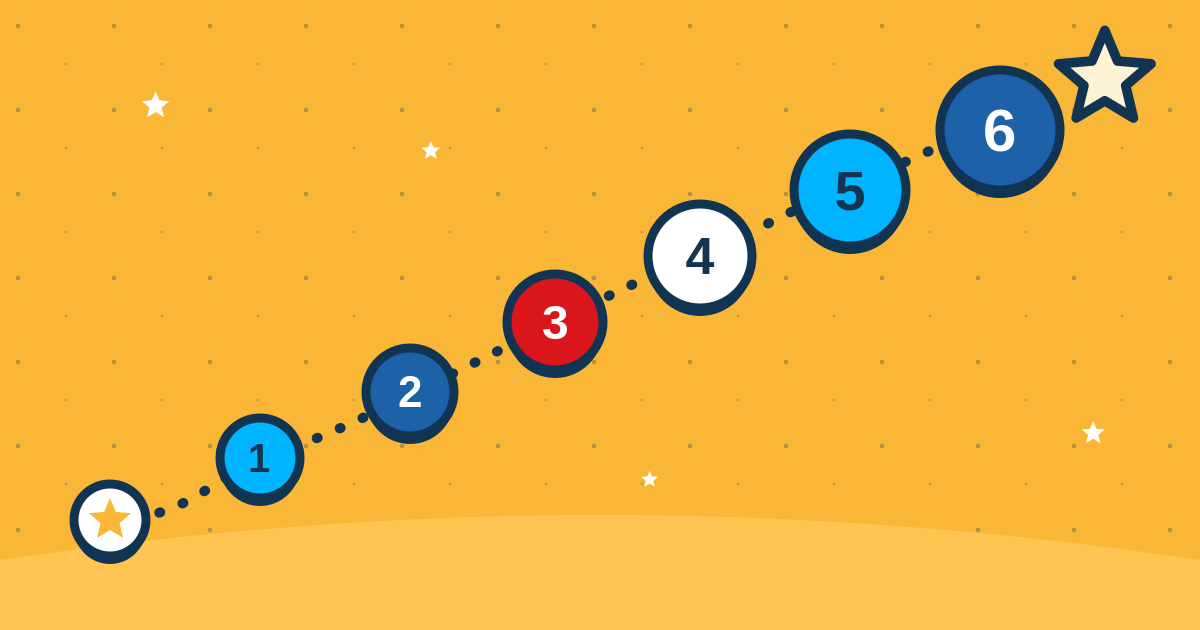
Math is a staircase
Each topic rests on the one before it. That’s why many topics come back from one grade to the next, each time with bigger numbers and harder problems. A child who didn’t quite grasp tens in grade 1 will stumble over subtraction in grade 2, even if subtraction looks like the problem.
Keep this in mind as you read the list: when your child struggles with a topic, the cause is often one or two steps further down.
Preschool (pre-K and kindergarten)
- Counting objects and saying how many there are, first up to 10 and then beyond.
- Recognizing numbers and starting to write them.
- Comparing amounts and sizes: more, less, the same; long, short.
- Basic shapes: circle, square, triangle, rectangle.
- Simple patterns (red, blue, red, blue) and sorting objects.
Grade 1
- Numbers up to about 100; tens and ones.
- Adding and subtracting small numbers, and simple word problems.
- Measuring with steps, hand spans or pencils, and comparing lengths.
- Days of the week, months and first ideas about telling time.
- Recognizing coins.
Grade 2
- Numbers up to about 1,000; hundreds, tens and ones.
- Adding and subtracting with regrouping (what many of us learned as “carrying” and “borrowing”).
- Multiplication as repeated addition and the first times tables.
- Telling time on a clock and measuring with a ruler.
- Tally charts and simple pictographs.
Grade 3
- Numbers with four or more digits, and place value.
- Times tables and first divisions as sharing into equal groups.
- Simple fractions: a half, a third, a quarter.
- Length, weight, capacity, time and problems with money.
- Flat shapes, perimeter and bar graphs.
Grade 4
- Five- and six-digit numbers.
- Multiplying and dividing multi-digit numbers.
- Equivalent fractions; comparing and adding fractions with the same denominator.
- First decimals, closely tied to money.
- Angles, parallel and perpendicular lines, and area on a grid.
Grade 5
- Operations with fractions, including different denominators.
- Operations with decimals and how they relate to fractions.
- Multiples, factors and prime numbers.
- First ideas about percentages.
- Area and perimeter of different shapes; reading and interpreting graphs.
Grade 6
- Mixed operations with fractions and decimals.
- Percentages, ratios and proportions in everyday problems.
- Circles; volume of simple solids.
- Averages and simple probability.
- Multi-step problems that call for a plan before calculating.
How to help at home, stage by stage
Preschool to grade 2
At this age, math is learned with the hands. Count the stairs, the plates on the table or the red cars in the traffic jam. Cook together and measure with cups and spoons. Board games with dice are counting and addition practice dressed up as fun.
Grades 3 and 4
Times tables stick with short, frequent practice, not long sessions the night before a test. Five minutes in the car, or a quick-fire quiz at dinner, does more than an hour on Sunday. For fractions, nothing beats sharing a pizza or a tortilla among the family.
Grades 5 and 6
Bring math into real decisions: which deal is better at the supermarket, how much a discount saves, how long a trip to the interior will take. And ask your child to explain how they solved a problem. If they can explain it, they understood it.
Signs your child may need extra support
- They still count one by one to solve sums that, at their grade, are usually done with faster strategies, and it wears them out.
- They avoid math homework or say things like “I’m bad with numbers.”
- They do the exercises mechanically but can’t explain why they work.
- They find it very hard to handle a topic that, according to the plan, was covered the year before.
- Their grades keep dropping in topics that underpin what comes next: place value, times tables, fractions.
None of these signs is a diagnosis. They are reasons to talk with the teacher and look together for the missing step. If the difficulty seems to go beyond math, the school can advise you on whom to consult.
One last thought
Comparing your child with a cousin or the classmate at the next desk rarely helps. Every child climbs the staircase at their own pace, and what matters is that each step is solid before moving on to the next.
That’s the idea behind Academia Espacial Junior, starting with math: progress counts when your child masters an objective, not for the time they spend in front of a screen.